
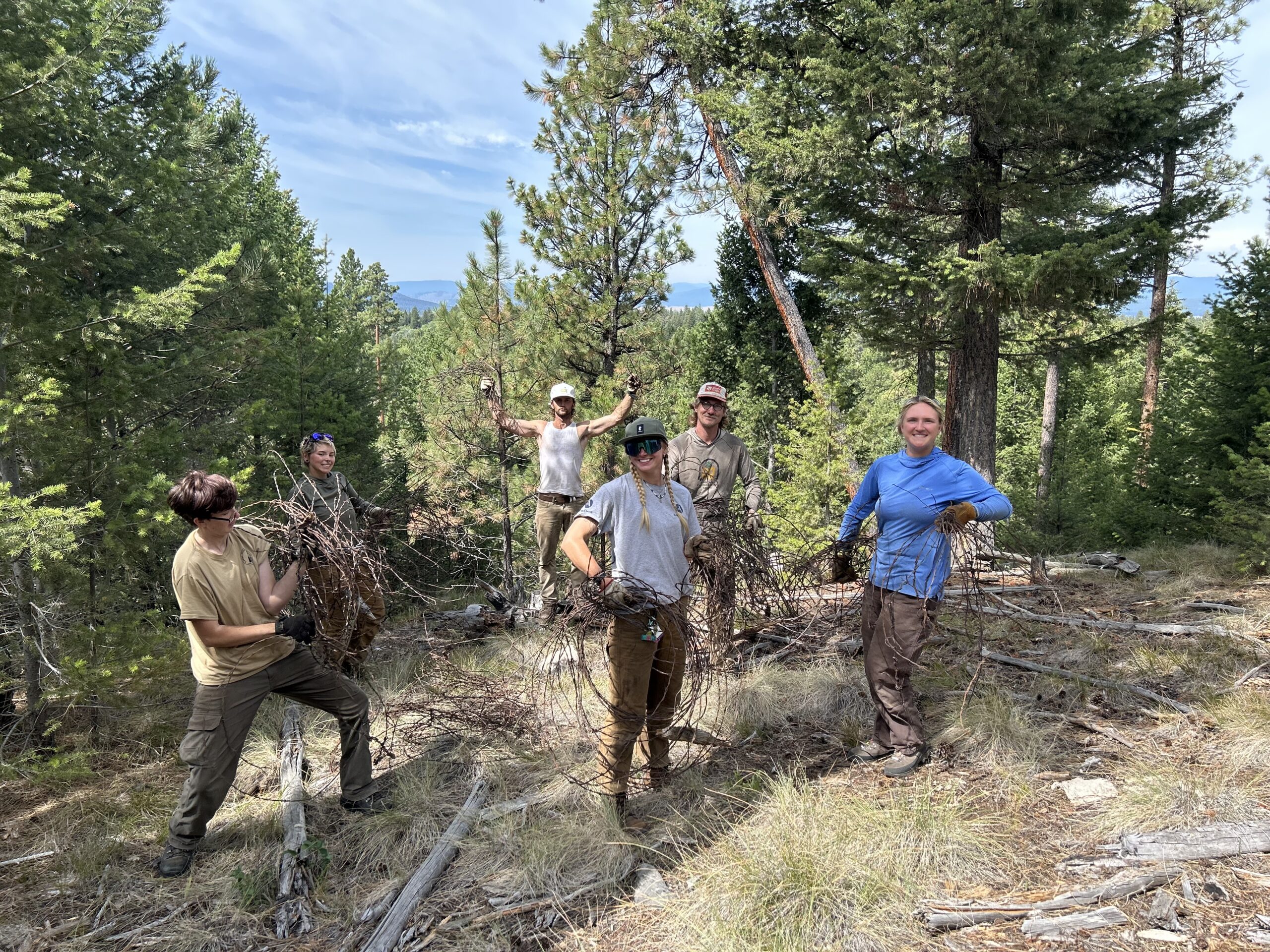
In 2025, the Blackfoot Challenge responded to expanding community priorities with new programs – Science and Recreation Stewardship – led by new staff. A year of extreme drought tested the annual drought response program and informed ideas about enhancing long-term drought resilience across the watershed. Partners hosted a successful two-week prescribed fire training workshop to increase expertise and adoption of prescribed fire as a forest resilience tool. Meanwhile continued conifer encroachment treatments improved habitat for rare, native birds as well as grazing lands across ownership boundaries. The list of outcomes that follows stems from trust-based working partnerships, stewardship-focused landowners, and the generous financial and technical resources contributed by many.
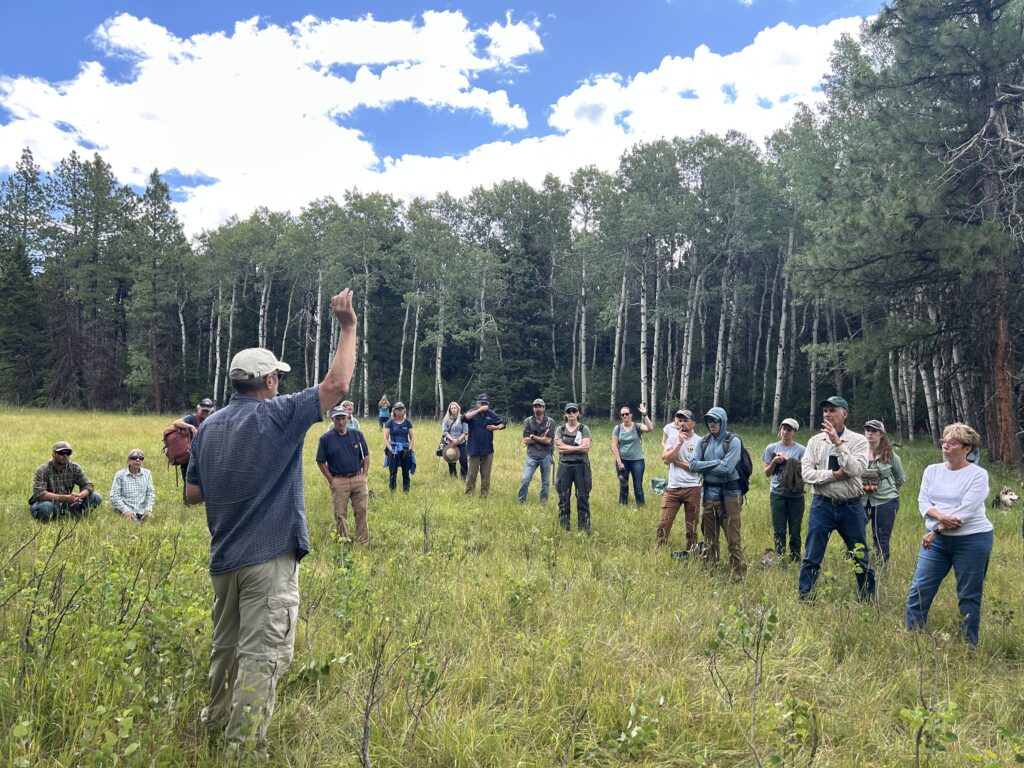
In July, landowners and partners learned about aspen ecology and conservation from one of the nation’s leading experts, Dr. Paul Rogers.
BLACKFOOT BIRDS
- Conducted FeederWatch Surveys through Cornell Laboratory of Ornithology and participated in Cornell Lab’s Great Backyard Bird Count.
- Hosted community bird walk for 20 guests led by Drs. Erick and Anne Greene.
- Participated in Wild Wings Bird Festival in Missoula and led two bird tours in the middle Blackfoot.
- Engaged members in community science program to monitor common loons and shared annual loon survey results. Also met with Coopers Lake landowners about ways to reduce disturbance to loons; installed buoys around Upsata Lake loon nest to decrease disturbance from boats.
- Coordinated citizen science long-billed curlew surveys with Montana Audubon.
- Monitored trumpeter swan territories for nest success, cygnet production, and fledging throughout the watershed and adjacent Swan Valley. Compiled survey data for the region for state and federal partners.
- Visited Clearwater landowner to assess bird habitat and grassland restoration project.
- Conducted surveys of Brewer’s sparrows and other grassland birds near Brown’s Lake and Kleinschmidt Lake to assess benefits of conifer removal on native birds.
- Co-led Wild Montana public hike and birdwatching excursion around the BCCA.
- Participated in field trip with Old Salt Kinship Program students and presented on grassland birds, conifer removal, and habitat enhancement.
- Presented on Blackfoot Trumpeter Swan Restoration Project during USFWS Partners Program leadership tour.
- Presented on trumpeter swan and common loon biology and conservation to more than 100 students at Blackfoot Challenge Youth Field Day at Upsata Lake.
- Drafted recommendations for grassland bird species related to management and grazing prescriptions for land stewardship program.
BLACKFOOT COMMUNITY CONSERVATION AREA
- Facilitated six council meetings and eight work group meetings to discuss issues and make management decisions based on the BCCA Management Plan.
- Completed follow-up treatments on 240 acres of mechanical thinning including broadcast seeding and weed control along the north boundary of the BCCA core. Project was designed to reduce the risk of catastrophic wildfires, enhance wildlife habitat, and improve stand resilience. Initiated a second NRCS EQIP contract as part of the North Ovando Fuel Reduction Targeted Implementation Plan (TIP).
- Continued to coordinate with Montana Fish, Wildlife and Parks (FWP) on future cross-boundary forest management.
- Coordinated with Forestry & Prescribed Fire Program Coordinator to prep six prescribed fire units totaling 500 acres with help from Montana Conservation Corps and Greyback Forestry. Prescribed burning of one to two units was planned; however, conditions did not align and projects were postponed to 2026.
- Controlled invasive weeds on road systems, forest treatment areas, and native prairies across more than 200 acres using biological controls, chemical application, and hand-pulling.
- Coordinated with Powell County Noxious Weed Coordinator on the first year (of five) of the Wildlife Habitat Improvement Program project. Three herbicide applicators were contracted to focus on different areas of the BCCA to improve timing and coverage on 160 acres.
- Hosted multiple events with university and volunteer groups to pull noxious weeds, remove old fence wire, repair gates, and maintain beaver dam analogs.
- Provided multiple presentations about the BCCA to visiting groups including local schools, university groups, and corporate donors.
- Participated in educational programs with watershed school groups, reaching more than 100 students.
- Provided year-round public access on 5,600 acres, including hiking trails, 8-week motorized use season, and hunting via the Block Management Program.
- Maintained the 3-mile hiking/skiing trail system including annual mowing/grooming.
- Applied for and received a Montana FWP Trail Stewardship Program grant to fund a new information kiosk, trail grooming, and interpretive signs.
- Deployed vehicle counters to better understand recreation volume and trends.
- Developed new information panels for the Boot Tree kiosk that summarize the history, stewardship, wildlife, and regulations of the BCCA. Began planning for six interpretive signs around the Boot Tree wetland loop trail for self-guided walks.
- Administered and maintained the seasonal, cross-boundary motorized loop in partnership with the U.S. Forest Service and Montana Department of Natural Resources and Conservation.
- Implemented the NRCS Conservation Stewardship Program, completing multiple conservation enhancements, including wildlife-friendly fencing, forest treatments, noxious weed control, and vegetation monitoring.
- Maintained two beaver dam analogs (BDAs) as a demonstration to enhance wetland habitat, reconnect flood plain, and improve late season stock water.
- In cooperation with Montana FWP and BC Water Program, developed a proposal to the BCCA council to expand BDAs and reintroduce beavers to Warren Creek. The Recreation, Education and Wildlife (REW) Work Group supported the proposal and will recommend adoption to the BCCA Council in 2026. Installed two additional off-stream stock tanks to reduce pressure on riparian areas and enhance rotational grazing system.
EDUCATION
- Provided Boone and Crockett Trail Cam 101 lessons to Helmville School followed by a trail cam monitoring project on the school campus.
- Provided Bear Smart/Bear Aware lessons to Helmville School, Ovando School, Lincoln Elementary School, Lincoln High School, and Potomac School.
- Coordinated an amphibians and reptiles lesson at Helmville School.
- Coordinated an Introduction to Avalanche Safety class with Tyler’s Backcountry Awareness and Rich Ranch for high school students.
- Provided “Snow and Tell” lessons on measuring snowpack for Potomac and Seeley Lake Middle School students and K-8 students from Sunset School.
- Hosted Smoke Elser community event in Ovando, including storytelling about his Bob Marshall Wilderness adventures.
- Presented on collaborative conservation and wildlife conflict reduction methods to visiting Helena High School class.
- Coordinated an early morning sharptail grouse lek observation with Montana Fish, Wildlife and Parks (FWP) on a Helmville ranch where birds have been reintroduced.
- Hosted a tour for a wildlife biology class from University of Montana.
- Studied macroinvertebrates on Elk Creek on the Paws Up Ranch with the Little School of the Rockies and Montana Outdoor Science School.
- Coordinated a community presentation with Montana FWP on the sharptail grouse reintroduction project at the Helmville Community Center.
- Studied macroinvertebrates with Lincoln School on Nevada Creek.
- Presented a lesson on the Blackfoot Challenge and collaborative conservation to the Lincoln High School senior class.
- Provided a walk for watershed teachers where they could explore using wildlife apps to identify and learn about plants and birds.
- Provided lessons on the Blackfoot Challenge and macroinvertebrates to the PRO Outfitters kid’s camp.
- Hosted a prescribed burn tour of Gnome Knob and Lubrecht Experimental Forest for local firefighters and agency officials.
- Partnered with Clearwater Valley Bear Smart Working Group, Montana FWP, and USFWS to host a Bear Fair at the Seeley Lake Farmer’s Market.
- Partnered with Potomac community members, Clearwater Valley Bear Smart Working Group, Montana FWP, and the US Fish and Wildlife Service to host a Bear Expo at the Potomac Community Center.
- Awarded a $500 grant to Lincoln High School to purchase binoculars for their wildlife class. Awarded a $500 grant to Potomac School to help fund an overnight field trip to Camp Paxson.
- Implemented Annual Youth Field Day, with a full day of educational activities about wildlife for 130 students and teachers from six watershed schools at Upsata Lake. Hosted a community nature journaling class with artist/naturalist Claire Emery.
FORESTRY
- Facilitated 883 acres of prescribed burning on state and private lands and supported federal partner burns across another 628 acres.
- Completed 737 acres of forest thinning to improve forest health and reduce fire risk.
- Conducted or supported 25 outreach and education tours or events throughout thE Blackfoot to showcase prescribed fire effects and efforts.
- Participated in the newly formed Montana Statewide Prescribed Fire Council.
- Hosted the inaugural Blackfoot Prescribed Fire Training Exchange (TREX) workshop, offering prescribed fire field training and experience. Another is planned for 2026.
- Supported various fire and prescribed fire training efforts, including a Women in Wildland Fire course and an Intermediate Fire Behavior class (S-290) in collaboration with state and local partners.
- Developed a program around smoke awareness and prevention of dangerous levels of smoke exposure for area communities. Distributed 12 box fan air filters, purchased 20 air purifiers for community members, and acquired air monitors to set up clean air centers at Potomac and Sunset elementary schools.
- Attended the 11th Association for Fire Ecology Congress in New Orleans, learning about prescribed fire work happening worldwide. Toured prescribed fire work in northern Louisiana and southern Mississippi.
LAND STEWARDSHIP
- Conducted multiple property assessments and landowner meetings associated with NRCS stewardship programs resulting in greater awareness and participation.
- Helmville Valley Conifer Encroachment TIP: Completed more than 500 acres of treatments across multiple properties to conserve native bunchgrass communities and improve rare bird habitat.
- North Ovando Fuel Reduction TIP: Completed more than 300 acres of treatments to mitigate catastrophic wildfires and increase forest resiliency.
- Nevada Creek Restoration (Phase 8): Coordinated with Big Blackfoot Chapter of Trout Unlimited, U.S. Fish & Wildlife Service, and a landowner on developing a grazing management plan to support the stream restoration project. Coordinated installation of 2.5 miles of riparian fencing and a water gap/crossing to facilitate rotations and enhance riparian/stream channel conditions. Designed a pressurized stock water system for phases 7 and 8 to be implemented in 2026.
- Cottonwood Creek (Helmville): Worked closely with the grazing lessee to plan three large stock water systems for the property, one of which will support a 2026 stream restoration and irrigation efficiency project.
- Conducted a post-project review of biochar plots with interested landowners. Most plots showed a positive response during drought conditions emphasizing the benefits of biochar as a soil amendment.
- Through Blackfoot Soil Health Work Group, shared experiences and knowledge on bale grazing, cover crops, no-till seeding, biochar demos, and high stock density-short duration grazing.
- Together with NRCS and USFWS, continued to coordinate conifer encroachment removal projects in the Helmville area to conserve grassland/sage habitat and rangeland, benefiting rare native bird species.
- Coordinated with USFWS on development of 530-acre project on the Blackfoot and Kleinschmidt Waterfowl Production Areas to conserve sagebrush-bunchgrass prairie, with 90% of the project completed.
- Staff coordinated a three-day Aspen and Ecological Resilience Workshop for 65 participants in July. Local landowners, state and federal agency staff, and partner organizations enjoyed a half-day of presentations on aspen conservation followed by an all-day field tour, led by Dr. Paul Rogers from the Western Aspen Alliance. On the third day, staff met with Dr. Rogers to discuss watershed aspen goals.
- Staff completed a nine-week biochar course to increase understanding of biochar as a land stewardship tool. Authored a paper with Board member Dr. John Teller that described findings on isocupressic acid and biochar, reducing concerns that pine needles (in biochar) could cause late-term abortions in cows. Facilitated a soil health and grazing education station for Seeley-Swan High School reaching more than 80 students.
RECREATION
- Formalized the Recreation Committee in January and convened five committee meetings in 2025, with consistent participation from community members, recreation managers, and recreation professionals.
- In partnership with the Bureau of Land Management and Montana FWP, established a data collection protocol to gather baseline visitor use and impact data. Data effort will inform recreation resiliency projects across the watershed.
- Hired an Intern to support the 2025 pilot season of recreation data collection.
- Completed 598 recreation use and impact assessments focused on crowding at fishing access sites, dispersed camping, trail use, motorized and non-motorized use behind gates on public land, and social surveys at fishing access sites. Monitoring occurred at 23 fishing access sites and 15 land access sites.
- Placed game cameras at select high-use fishing access sites to measure crowding in parking lots during peak angling months.
- Recruited eight volunteers to assist with recreation use and data collection, with plans to expand the effort in 2026 to increase community involvement, strengthen collaboration, and build capacity around recreation stewardship.
- Advanced development of a data inventory project to improve understanding of recreational use, impacts, and trends in the Blackfoot watershed.
- In collaboration with the Education Program, began working with students from Lincoln High School to create a recreation ethics video focused on side-by-side vehicle safety. This is the first in a series of recreation ethics videos to be developed by local students.
- Formed Blackfoot Recreation Managers Work Group to work collaboratively across management boundaries to address issues and opportunities around recreation. Attended two workshops, gaining knowledge of recreation management, becoming familiar with tools that may help balance recreation impacts and landscape health, and forming relationships with recreation professionals across Montana.
SCIENCE
- Launched the Blackfoot Challenge Science Initiative and conducted watershed science needs assessment in coordination with staff, board members, landowners, ranchers, program committees, and agency partners.
- Began drafting a science strategic plan to guide long-term priorities.
- Initiated formation of a Science Expert Advisory Committee, recruiting experts in hydrology, wildlife biology, recreation science, climate and fire ecology, soil and rangelands, social science, and rural community development.
- Established science partnerships with the University of Montana, Montana Fish, Wildlife & Parks, U.S. Fish & Wildlife Service, Intermountain West Joint Venture, The Nature Conservancy, U.S. Forest Service, Rocky Mountain Elk Foundation, Colorado Mountain Club, Montana Climate Office, and others.
- Secured UM Affiliate Faculty and Principal Investigator status, enabling BC to co-apply for grants, host interns and graduate students, and collaborate on emerging research. Also secured Colorado State University Affiliate Faculty Status to broaden research collaboration opportunities.
- Served as collaborator or advisor on research related to carnivore coexistence, recreation monitoring, drought resilience, forest resilience, and rangeland systems.
- Water Stewardship & Drought Response – Identified priority hydrology data needs, coordinated with Montana Climate Office and others on groundwater–surface water interactions, and aligned drought-response decision tools with available climate and streamflow data.
- Forestry & Fire – Co-developed and helped host the Blackfoot Aspen Ecology Workshop; facilitated a multi-agency forest resilience meeting to align fuel treatments, prescribed fire priorities, and climate-informed forest planning.
- Wildlife Coexistence – Supported virtual fencing research and monitoring with ranchers; coordinated with Montana FWP and USFWS to align Blackfoot data needs with existing wildlife studies.
- Recreation Science – Designed and tested a recreator-use data collection protocol with the Recreation Program coordinator, UM, and Colorado Mountain Club.
- Soil & Rangeland Health – Identified soil and vegetation monitoring gaps with staff and landowners; supported integration of rangeland ecology and soil metrics into data priorities; developed proposal to support research around grazing systems.
- Began developing a watershed data management system and dashboard to integrate climate, water, wildlife, forest, recreation, and rangeland data.
- Partnered with Speedgoat Consulting to begin designing a cloud-based data platform capable of supporting cross-program analytics and community storytelling.
- Re-established the Conservation Strategies Committee and facilitated multiple partner meetings to renew land protection efforts across the watershed.
- Led development of the Blackfoot Watershed Conservation Strategy Framework, identifying gaps, conservation priorities, emerging threats, and opportunities to support working lands, including grass bank models, young rancher access, and federal funding alignment.
- Presented Blackfoot Science Initiative goals and work at state and national conferences, university seminars, and community learning events.
- Shared Blackfoot models and lessons with regional and national partners through workshops, leadership programs, and peer-learning exchanges.
VEGETATION
- Supported implementation of integrated noxious weed management for landowners, including providing native and exotic plant identification, herbicide application protocols, and biological control insect releases.
- Hosted two weed pulls at the Russell Gates Fishing Access Site for the 27th year.
- Began implementation of second Wildlife Habitat Improvement Program grant, revisiting previously treated areas and initiating noxious weed treatment on new areas within the BCCA core.
- Attended meetings as a member of the Montana Invasive Species Council.
- Administrated agreement to treat noxious weeds on DNRC land within the BCCA.
- Continued noxious weed treatment along the Blackfoot River corridor in Powell and Missoula counties utilizing BLM grant funding.
- Conducted post-treatment monitoring for vegetation management practices within the Nevada Creek Vegetation Management Area and completed Noxious Weed Trust Fund cost-share grant for that area.
- Administrated herbicide application on the Helmville Face as part of a USFS post-prescribed burn agreement.
- Held two noxious weed management informational programs in Ovando, providing continuing education credits for licensed pesticide applicators.
- Provided cooperative state and county right-of-way vegetation management through state and county agreements.
- Presented vegetation management and other program accomplishments in the watershed at the Montana Weed Control Association Southwest Area annual training and the North American Invasive Species Management Annual Conference. Assisted in education and field experiences for visiting groups on the BCCA and at BC Annual Youth Field Day.
WATER
- Working with the Blackfoot Drought Response Committee, managed a second consecutive year of extreme drought, marked by new all-time low flow records for 21 days in September on the Blackfoot River.
- Along with the Confederated Salish and Kootenai Tribes (CSKT) and Montana Fish, Wildlife, and Parks, coordinated the first ever water rights call on the 1904 instream-flow water right associated with the CSKT Water Compact.
- Coordinated with more than 80 drought response participants and developed plans with six new participants to ensure shared water conservation during the longest period of drought response in our history, extending last year’s record by 18 days.
- Completed the 16th year of our irrigation scheduling program, providing weekly irrigation information, tips, drought strategies, and soil health information to more than 100 irrigators throughout the watershed.
- Continued in our 6th year of soil moisture monitoring program in 18 locations throughout the watershed where irrigators track daily soil moisture information, manage irrigation applications, and test different irrigation or cropping strategies.
- Coordinated and supported partner efforts to collect the 4th year of data on a hydrologic study aiming to understand the Blackfoot River’s water budget at the watershed scale. Results are informing strategic water conservation efforts and building a dataset that will answer large-scale questions about water resources.
- Worked with multiple partners and landowners to collect data and plan restoration projects on more than 10 miles of degraded stream reaches in the middle and lower watershed. Restoration designs aim to benefit fisheries, improve drought resiliency, increase wetland habitats, and improve productivity of working lands.
- Initiated a process to update the Blackfoot Watershed Restoration Plan including forming a steering committee of restoration practitioners, resource managers, and tribal partners to guide the process. The planning effort will gather water quality and quantity data into an accessible watershed-wide database.
- Attended four workshops, gaining knowledge in aquatic invasive species ID and management, geospatial analysis tools, and ecological drought impacts.
- Presented at five outreach events reaching diverse audiences, including members of a local water quality advisory board, individuals involved in the Columbia Basin water transactions program, members from the Western Landowners Alliance, and international protected area managers attending the George Wright Parks Forum.
- Participated in four watershed education events, presenting on snow science, collaborative water management, drought resiliency, water conservation, and stream monitoring to more than 200 students and community members. In conjunction with Blackfoot Challenge Science Program, initiated planning several high priority projects to gather data on ground-surface water interactions, soil health implications on water availability and drought resilience, and watershed-wide hydrological conditions and trends via remotely sensed data.
WILDLIFE
- Completed eight high-priority electric fence projects, thanks to partnerships and funding through NRCS and an America the Beautiful grant with Heart of the Rockies.
- Upgraded one existing electric fence from a standard five-wire design to a seven-wire bipolar design to improve effectiveness.
- Built a new test site equipped with game cameras to study bear responses to various electric fence and drive-over electric mat configurations and technologies.
- Provided a 20-foot electric drive over mat to Canada’s Waterton Biosphere Region, where it was installed at a livestock compost site on a Hutterite colony.
- Hosted an electric fence workshop with representatives from Mountain West Co-Op, Tru Test and Speedrite to share current technologies and information. NGO staff, state and federal partners, landowners and ranch managers attended.
- Loaned out six temporary electric net fence kits for chicken coops and food storage.
- Purchased and delivered two 20-foot shipping containers to landowners for storing bulk livestock feed to reduce bear attractants.
- Set up several electric fence monitoring systems on permanent electric fences in the watershed. Based on positive feedback, planning to install more monitors in 2026 to assist landowners with ensuring fences are operational.
- Attended the International Human Bear Conflict Workshop in Kalispell.
- Provided a temporary electric fence with a 12-foot drive over electric mat around the primary Old Salt Festival camping area. Aso provided several cans of bear spray, nine Kodiak bear-resistant garbage cans, and volunteer garbage management services to reduce bear attractants and prevent conflicts at the event.
- Ordered four bear-proof Bear Saver “Beariers” to enclose garbage bins on one ranch with larger numbers of grizzly bears seeking food sources.
- Hired additional help to maintain electric fences at the Ovando dump, Helmville dump and carcass compost site.
- Employed three range riders to monitor grazing livestock and predator activity in areas around Potomac, Greenough, Ovando, Helmville and Lincoln. The range riders covered more than 70,000 acres working with multiple ranches.
- In partnership with Western Landowners Alliance and Heart of the Rockies, hosted a spring range rider training event for landowners, watershed groups and partners in Dillon, Mont., which we hope will become an annual event.
- With ranchers, Montana FWP, Defenders of Wildlife, and Wildlife Services, set up turbo fladry at two ranches during calving season to reduce conflicts with wolves.
- Managed annual carcass pickup program, delivering more than 600 livestock carcasses to the composting site. Employed drivers for primary pick-up season during calving, as well as for on-call pick-up outside of calving season. Services covered the Blackfoot watershed as well as several neighboring communities.
- Distributed 150+ free cans of bear spray to ranchers, hunters, recreationists and community members throughout the watershed.
- Continued to work on developing Bear Aware / Bear Smart communities. Outreach included several school presentations, community events and group tours that integrated bear aware information.
- Partnered with Clearwater Bear Smart Working Group to support outreach events, fundraising and distributing bear-resistant garbage cans in the Seeley area.
- Placed 90+ Kodiak bear resistant garbage cans across the watershed, including 609 cans in the Seeley Lake area and 30 in the Lincoln area.
- Employed our annual Elk Hunt Coordinator to support ranchers by coordinating hunter access during the early and late elk hunt shoulder seasons.
- Mentored a UM undergraduate student who supported the Wildlife Program and gained experience through giving bear-aware presentations, taking part in tours, helping with grizzly bear DNA hair sample collection, installing electric fence projects, and managing attractants at the Old Salt Festival.
- Assisted Montana FWP with grizzly bear management and research efforts.